The Freezer Test.
My sister-in-law asked me recently for advice on an encaustic piece they bought when they first married (before I even started working in encaustic). It’s a large piece (36×80) and created by an established artist who worked with a well-known gallery.
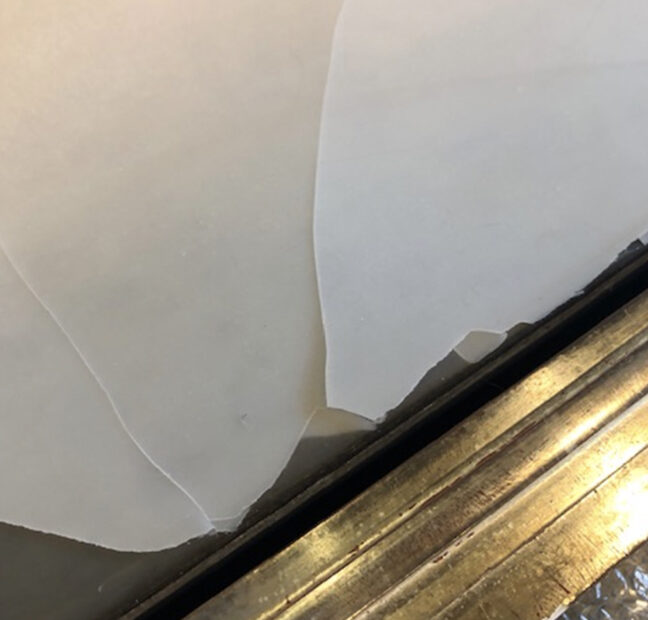
During a remodeling project it had been taken off the wall, moved out, and put into storage with a reputable framer before being reframed — and somewhere along the way it delaminated.
The wax had split off the surface in sheets. Whole panels of it, separated clean from what was underneath.
So, the question arises—who is at fault. Is it the artist? The movers? Or the framers who had it in storage? Was it bumped, dropped, or exposed to the cold Minnesota weather for too long? It’s almost impossible to know.
This piece was purchased more than 20 years ago and has been just fine through several moves. But for some reason—not this time.
It’s an oil painting that had wax poured over the top. Pouring wax over a surface doesn’t fuse it. Fusing isn’t a finishing step — it’s the reason a piece holds together at all. Each layer must be melted into the one below it, and into the substrate underneath, until the piece stops behaving like layers and starts behaving like one solid thing. A piece that’s genuinely fused doesn’t delaminate in sheets, because there’s nothing left to separate.
Skip that step, or leave it incomplete, and the layers are just stacked. Eventually they may separate, sometimes in sheets, the way this one did.
I see a lot of experimentation online with materials and shortcuts and am concerned that the integrity of the artwork is being compromised. Just because the wax didn’t delaminate immediately doesn’t mean it never will. It can take years. If someone is paying hundreds, thousands, sometimes tens of thousands of dollars for a piece, it should last. The Fayum portraits are still intact after two thousand years for a reason.
A properly fused piece can still chip or crack if you bump or drop it — that’s just physical impact, and no amount of fusing prevents that. What it won’t do is delaminate. The layers stay fused as one piece rather than separating into sheets the way this one did.
Here’s how you find out if your own work is properly fused. This test can ruin the piece and that is exactly what you need to know.
It’s called the freezer test. Put your piece, or a test panel if your piece is too big, in a freezer for four to six hours. Freeze it completely. If it cracks or delaminates from that alone, you have your answer already. If you’re lucky enough, like me, to live in a freezing, you can test your large works 4 months out of the year by just putting them on your back porch or in your garage.
If it survives the freezer, let it come back to room temperature for about an hour. Then slam it, edge-first, against the corner of a table.
If it doesn’t shatter or separate, you can be confident that your layers are fully fused and the wax has adhered to the substrate.
I know this may seem harsh to deliberately try to destroy a piece you might love, on the chance it fails. But you’re much better off finding that out now, on a test piece or an early piece, then watch it happen years later to a piece someone paid you for. The way it happened to my brother and sister-in-law.
I’m here to help you learn about the best practices and sound techniques, so this won’t happen to one of your pieces. If you’re a photographer and this is new territory for you, my 6-module course, The Artistic Image, starts at the beginning and teaches fusing and the fundamentals properly, so your work holds up.
What has been your experience with encaustic delaminating?
Be well….be creative,
Clare
Learn how photographs, wax, and intuition come together.
View my photo encaustic classes, courses, and workshops.