Well, it finally happened……
Sharing your artwork online is always a double-edged sword. You want people to experience your art, but visibility also opens the door to misappropriation and theft.
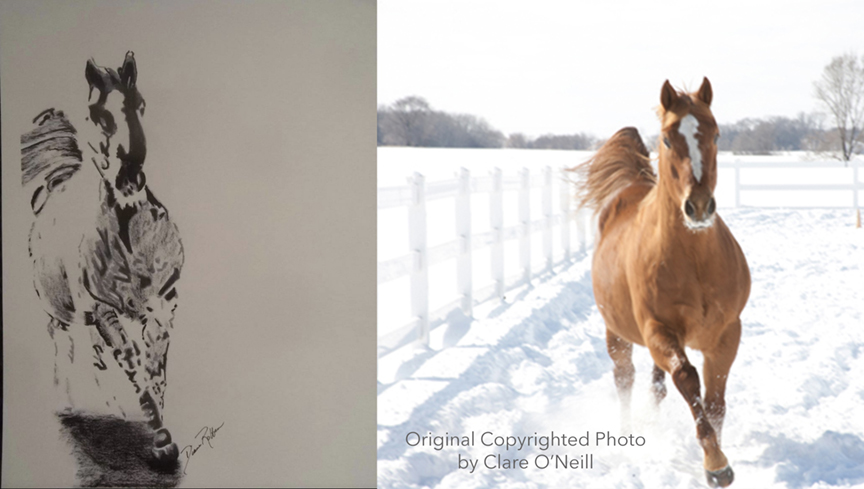
Last week, I came across an image that was unmistakably mine—being passed off as another artist’s work.
From what I can tell, she traced my original photograph, signed it, and posted it on Facebook and Instagram as her own. Overlaying the two images in Photoshop made it obvious: they were identical.
And she didn’t just steal the image.
She created an entire elaborate story to go with it:
“To tell the story in 2D begins with some fast moving horsepower… this amazing horse came running toward me… even though this happened a couple years ago, the photos I took bring back the intensity of the day.”
It was brazen.
So what did I do?
After the initial shock, I called her out publicly and shared the situation with my network. The response was immediate. Artists flooded her posts with clear, firm, civil reminders that stealing artwork is unacceptable.
She attempted to defend herself by posting a so-called “reference photo” that looked nothing like either image. It was a flimsy attempt at covering her tracks.
A few people wondered whether this was cyberbullying. It wasn’t. No threats, no harassment—just artists standing up for what’s right. Calling out art theft is not bullying. It’s protecting your livelihood and your creative integrity.
Facebook and Instagram eventually removed her posts—whether by platform action or by her own panic, I don’t know.
But there’s a bigger issue here:
Using someone else’s creative work—whether it’s a photo, a song, a design, or a visual style—is intellectual property theft. Period.
I see this constantly:
-
Students using photos they didn’t take
-
Artists using “found images” online in their encaustic work
-
Videos posted with copyrighted music
-
Marketing materials built on someone else’s photography
None of it is okay.
A photograph is copyrighted from the moment it’s created, watermark or no watermark.
Yes, there are copyright-free and Creative Commons images available online. Use those if needed. But using someone else’s protected image—especially in work you plan to sell or share—puts you on very thin legal and ethical ice.
Unfortunately, international image theft is common, and often impossible to fight. But here in the U.S., you do have options:
How to Protect Your Artwork Online
- Report the infringement—Facebook, Instagram, and most platforms have an easy “report intellectual property violation” form.
- Register your images with the U.S. Copyright Office—You can register up to 750 images at once for a small fee. This strengthens your legal rights significantly.
- Learn how to issue a DMCA takedown—The Digital Millennium Copyright Act gives you strong tools to force removal of stolen content.
- Use Google Reverse Image Search—Patrol your images online and look for unauthorized use.
- Send a cease-and-desist letter—It’s often enough to make the infringer back down.
- Watermark your images (visible or invisible)—Services like Digimarc embed hidden digital watermarks that can’t be removed.
Art theft happens far too often. Let’s stay vigilant and speak up when we see it.
This particular infringer has agreed to stop posting the stolen image and send me the original, which she did. But if you see my artwork anywhere, please notify me immediately—I won’t hesitate to take stronger action.
Artists must protect each other.
And our work deserves respect.
What experiences have you had with this issue? Would love to know how you resolved it.
Be well….be creative,
Clare
Learn how photographs, wax, and intuition come together.
View my photo encaustic classes, courses, and workshops.
Im glad that her images (of your photos) were removed. I think that you should have named her here, because this may not have been her first time doing this and may not be her last. No one should ever have to worry about their artwork or images being stolen.
She took the images down, so I’m good with that. No need to berate her further. I’ll be monitoring her though.
Wow, that is brazen! Especially the story…not even claiming that it is fair use, just flat out appropriating. This is what gives me pause about putting my art online. But then if you don’t how do you get customers and recognition? It’s a conundrum. Thank you for your suggestions and post.
Erica, I think that is the thing that bothers me most….the story like she was there.
Hi Clare,
I’m sorry you had to deal with this but you’re right, I think sooner or later we all do. My preference for addressing copyright infringement is to privately message the person first and give them the chance to do the right thing. I think the public disclosure can get messy fast and I think overall, just leads to more drama than what is needed. This way has always worked for me.
Ironically and unfortunately, I had a person claim that I stole one of her images. She did this publicly and didn’t stop until I found the original image file that clearly showed that while we may have photographed the same building they were no way the same image. She apologized but not until she had done some major harm. Because a lot of people assume that an accusation is always correct…. if not entirely, at least partially. And that’s simply not true.
I think your bullet points are all good ones and I think we do have to watch out for our friends and colleagues too. It’s definitely a catch 22 when we dive into the virtual world. Hopefully the benefits far out weigh the risks though.
Thanks as always for your insights and for sharing your wisdom and talent!
Peace,
Jamie
Thanks for your comments Jamie. It’s a messy situation all around. I’m glad you had the original photo to prove it was your image. Shows we need to be diligent on using our own images and keeping documentation.
While I am not a lawyer, my understanding is that registering with the copyright office is important if you need to take legal action. Apparently, there is not enough money in it for a lawyer if you depend on your unregistered natural copyright.
Yes, always a good idea to register!
I’m glad you got this sorted out Clare. I was angry on your behalf when I saw your post and then read her rather pathetic attempt to say it was one of her photos (which it very obviously wasn’t!)
A question: I’ve only ever posted a couple of videos on my Instagram feed of some of my work and the radio was playing in the background. I hadn’t really noticed the song until I played back the video once it was online and I quite liked the music so I left it. Would this be an infringement on Coldplay’s copyright even if it was playing on the radio at the time and I hadn’t downloaded it specifically for a video edited by myself?
It’s quite a minefield out there!
Here’s to a more peaceful week,
Cinny
Thanks Cinny. Yes, unfortunately, it is an infringement on Coldplay. I get it though….it’s probably really nice for your video. You can go out and get Royalty Free music that will not cross any lines. Sorry to be the bearer of bad news.
Thank you for making me think about it!!! Really appreciate it as it would have been totally unintentional. Next time I do any videoing I’ll make sure there’s no music playing in the background.
Great info, thanks Clare.
Thanks Sandy:)