Combining Oil and Wax is tricky.
Oil and wax have always been a magical combination for me. Almost every piece I create includes at least some oil paint because the layered richness, depth, and luminosity it creates is unlike anything else. There’s an opulence to oil over wax that can transform a piece, adding movement and emotion in unexpected ways.
But as beautiful as this combination is, it doesn’t come without challenges.
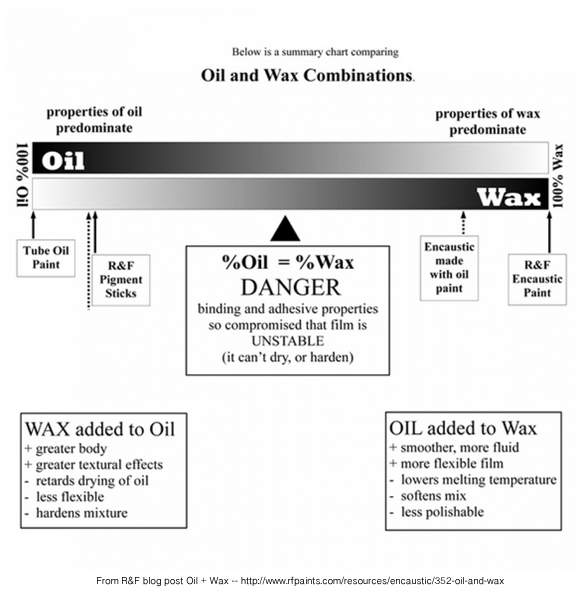
Although oil and wax are chemically compatible, the problems begin when they’re used in the wrong ratios. Think of wax and oil as existing on a spectrum. On one end, a small amount of wax is added to oil paint to give it more body—R&F Pigment Sticks are a great example of this. They contain less than 15% wax, so the oil remains dominant, and the paint behaves like a buttery, moldable stick.
On the other end of the spectrum, if you stir a small amount of oil paint into molten wax, the wax remains dominant. This is how many artists create their own encaustic paint colors, though the added oil lowers the melting temperature and softens the finish.
The real trouble happens in the middle—the “danger zone.”
This is the 50/50 ratio where wax and oil compromise each other so much that the mixture becomes gummy and unstable. It won’t dry. It won’t cure. It never fully hardens. And once you’re in the danger zone, there’s no saving the mixture.
If you’ve taken my in-person workshops, you’ve heard me harp on this endlessly: stay far, far away from equal parts oil and wax.
When I work with oil, I’m always conscious of how much I’m adding. I use both traditional oil paints straight from the tube and R&F Pigment Sticks, depending on the color palette I’m looking for. Both behave similarly, though the sticks give a buttery application I love.
Sometimes I layer oil beneath my tissue-paper image to build depth. Other times I add it on top to help the photograph emerge more vividly from the wax. I often fill incised marks with oil, or cover large areas with color and wipe it back using walnut oil or a light vegetable oil. If the surface feels too oily, I let it dry a day or two before fusing so the wax-to-oil ratio stays balanced.
If I ever think I’m approaching too much oil, I simply add another layer or two of wax. More wax = a safer ratio.
Fusing also plays a role. A longer fuse may cause the oil to diffuse into the wax, creating soft, mysterious mottling. And when applying encaustic medium over wet oil paint, always clean your brush thoroughly before returning it to the wax pot.
I’ve experimented with making my own encaustic colors by mixing oil paint into molten medium, but personally I didn’t love the waxy feel it produced. Now I prefer to use high-quality encaustic paints from Enkaustikos and R&F Paints.
And truly… this is just the beginning of what’s possible with oil and wax. The effects are limitless. Push, play, explore—and experiment boldly. Just remember: stay out of the danger zone.
What has been your experience with mixing oil and wax in your encaustic work? Let me know in the comments below.
Be well….be creative,
Clare
Learn how photographs, wax, and intuition come together.
View my photo encaustic classes, courses, and workshops.
Thank you for this detailed explanation. I have been fusing directly after wiping with cocounut oil and I often get the “moddled” phenomenon – or I fuse too long after painting with oil paints. This mistake has made for some very frustrating experiences.
It’s a really common mistake Nicole….and I totally get your frustration. Just keep in mind not to use too much oil and if you are thinking you’re using too much, build up more wax on the piece to keep the oil to wax ratio in balance.
Great article, Clare! Thanks for always guiding and teaching.
Thanks Patty. Glad it was helpful!
I, too, have had both bad and good experiences with too much oil. Sometimes I like the muddled effect. But I do get confused when you or others refer, at different times to encaustic paint and pigment sticks. Could you please explain the difference if there is any? Or is the difference just in how Encaustikos and R&F label the same thing?
Encaustic paint is a solid wax that needs to be molten to be applied. It’s about 85% medium (mix of damar and beeswax) and 15% pigment (usually in the powdered form) that is mixed and manufactured by companies like R&F Paints and Encaustikos. When people refer to pigment sticks they are usually referring to R&F Pigment sticks which are about 85% oil paint and 15% medium. They come in stick form and have the consistency of butter or lipstick. The two products are similar in their ingredients but differ greatly in their percentages of oil and wax. Encaustic paint has a low percentage of pigment and it’s a dry pigment so we don’t worry about the oil to wax ratio with this material. The pigment stick on the other hand is largely oil paint, so we need to worry about the oil to wax ratio using this material.They are also applied to the board very differently….one needs to be molten to be applied and the other goes directly onto the board with your fingers or a brush.
Hi Clare. I appreciate these tips. The details are very helpful and I love a good graphic! I constantly lust after more studio time but I am drawing ever closer to the day when that becomes possible. Have you tried Hylla Evans Encaustics? They are very heavily pigmented. I love working with them.
Hi Nancy….sounds like you are thinking of retiring! Yes, I do know of Hylla Evans and her encaustics. I’m so glad you like working with them.
So if we would like to try and make our own encaustic paint, we should mix about 15% of oil paint that has sat on a paper towel for a couple of days (to pull out some of the oil) with 85% wax medium?
Yes, that will work. But know it’s not the same as purchasing manufactures paints that use a powder pigment rather than oil paint. It has a slightly different consistency…..and don’t try to do any photo transfers directly on anything with oil in it. It will not work. You would need to put a layer of medium down first before doing a transfer if you are using paints you mixed yourself.
I have been using the RF Pigment sticks mixed with the RF blending medium and applied by hand or with a shop towel as a glaze over encaustic paint or medium. It gives a gorgeous color shift and pops the color already there. I often incorporate my photos printed on vellum or rag paper into the pieces and this gives me a great way to enhance the color and make them other worldly. I fuse it lightly. After a few days it still seems to be giving off color if buffed with a clean cloth. Any idea how long it takes for the pigment stick/blending medium to cure? Would fusing it after a week or so help? I love the look of it but am still trying to figure a few things out. Suggestions?
If you’ve fused and are still getting color on your clean cloth you probably have too much oil to wax ratio. You’re base of encaustic medium/paint most likely wasn’t enough to ‘hold’ all the oil you are using.
Thank you for this article. I’m just now branching out to add the oil paintsticks with my encaustic art and you have answered several of my questions. Thank you!
Hi, Clare. Can you please kindly tell me how to remove excess vegetable oil from the surface of an encaustic piece? I used an oil stick on it and used too much vegetable oil to remove the excess and now the surface is very sticky. I did try to remove it with a paper towel but it’s still sticky. Will windex cause erosion of the wax? Will soap and water work? Many thanks!!
I just wipe as much as I can off with a paper towel. Sometimes if it’s still really sticky I’ll wait 24 hours and then fuse. The small amount of oil that drops into the layer below is fine…..you just don’t want to do it too many times so that your oil to wax ratio is off.
I have no idea how Windex and wax will react. You’ll want to google what Windex is made of and think about those materials and how they might interact with wax and if they will erode your work. Again, what soap are you using and what are the materials it’s made of?
Hi, I came across this posting, since I follow your site —
QUESTION: I’m fairly new to encaustic, and experimenting with photos, and other media. I’ve been using encaustic medium over old OIL paintings (they’re on panels, not canvas) to great effect. But now I’ve been warned that might not be a good idea, that the wax might delaminate over time. I havent found much info on this, since most links are to R&F oil pigment sticks, which I’m not using.
does you have any advice or experience? maybe sand the oil paintings down lightly before ‘encausticizing’ them? or is it not a good process? the paintings are fully dry, and I have a stack of them
thank you for any suggestions
If the encaustic bonds properly to the oil painting you should be good. If it doesn’t then you run the risk of them delaminating. This may happen tomorrow and it might happen 10 years from now.
I might try the freezer test by putting them in the freezer (or outside if you live in a super cold climate), bring them back to temperature and slap them on the table or cement ground. This will surely tell you if the bond is not there. If they don’t crack, they could still delaminate over time….we just don’t know. That’s why we use a porous surface to begin encaustic paintings. The question really is how porous are your painting for the wax to bind to the substrate.
If you are selling your work you are going to want to make absolutely sure it’s bonded. In my opinion it’s not worth it if selling them. If not selling them….by all means go for it.