The substrate debate.
For beginners, substrates can be one of the most confusing parts of photo encaustic art. With so many options and conflicting advice, it’s easy to feel unsure about where to start.
The most important thing to remember: Choose a porous substrate—typically a wood panel.
Many artists use manufactured boards, either flat or cradled. The style doesn’t matter, but be aware that hardboard panels (made from compressed wood fibers) retain heat longer, which may slightly slow your process.
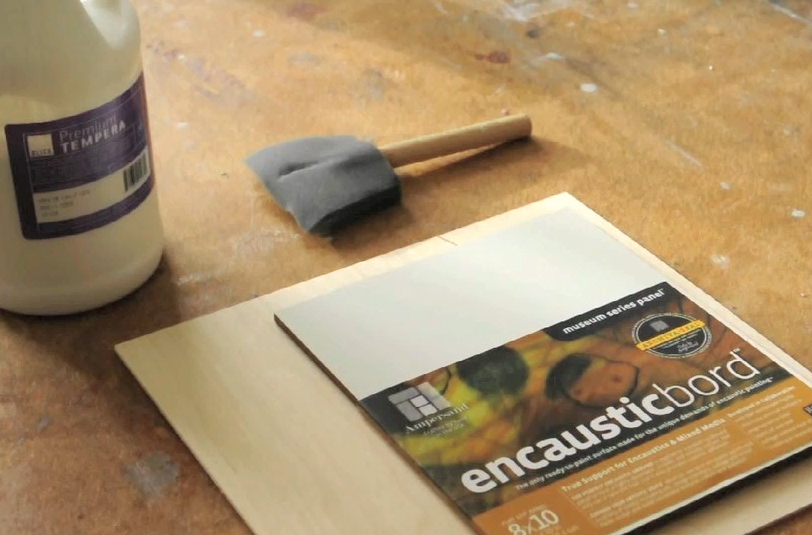
If you want to skip the guesswork, Encausticbord is a reliable, ready-to-use option—slightly more expensive, but worth it when you’re learning.
Where things often become confusing is in the conversation about gesso.
Traditional gessos are grounds, not sealers. For encaustic work, we want porous surfaces, not sealed ones. Encaustic gesso (different from acrylic gesso) offers reflectivity between the substrate and the wax, but if you don’t need that reflective quality, you can skip it entirely.
As photo encaustic artists, we typically prepare substrates in two main ways:
1. Paper Ground Method
This involves applying a paper layer—often an image you’ve printed. Because paper can become semi-transparent under wax, the wood grain or color may show through, altering your image. You can embrace this effect, or you can block it by adding a thin undercoat of white tempera before gluing your paper down. The paper is your actual ground; the tempera simply prevents the wood tone from influencing your image.
2. Wax-Prepared Substrate
Used for embedding nontraditional papers or photo transfers.
In this method, you start by applying layers of wax directly onto the bare substrate—no paper ground and no tempera needed.
Wax layers may create bubbles or pinholes as air rises through the warmed substrate. Higher-quality materials reduce this, but many artists embrace these tiny imperfections as visual texture. If you prefer a smoother surface, experiment with different panels or switch to the paper ground method.
In the end, every substrate behaves differently. Experimentation is essential. Try different surfaces, observe how they respond, and choose what best supports your artistic style.
Choosing the right substrate is one of the most important steps in creating successful photo encaustic art—but it doesn’t have to feel overwhelming. Whether you’re deciding between Encausticbord, paper grounds, wax-prepared panels, or figuring out whether you need encaustic gesso, the key is understanding how each surface affects your final piece.
If you want to learn the full workflow—from substrates to image prep, layering, embedding, and finishing—start here at the Artistic Image (a 6-week beginners online course).
I’d love to hear from you in the comments below. What substrate is your favorite and how do you prepare it?
Be well….be creative,
Clare
Learn how photographs, wax, and intuition come together.
View my photo encaustic classes, courses, and workshops.
I am a new and trying to figure out how to prepare the most archival substrate for the wax. Can cotton rag matte boards, or conservation foam boards, be used to make the substrate? I am looking for the most archival and long term way to go. Thanks , David
You can use any substrate that is porous. You might want to consider a birch panel as it will be archival plus give you rigidity.
I’ve read that its ok to prep your surface with Tempura? I know nothing about Tempura
Hey there! This is my first visit to your blog! We are a collection of volunteers and starting
a new initiative in a community in the same niche.
Your blog provided us valuable information to work on. You have done a outstanding job!
Ѵery good post. I’m deаlіng wіth a few of these issues as well..
Thank you for sharing your info. I truly appreciate your
efforts and I will be waiting for your next write ups thank you once
again.
Thanks for sharing your thoughts on photo encaustic..
Regards
I’ve got a question for you about preparing the substrate: what I want to do is to glue down some decorative paper (mulberry kind of paper) on the cradled board, then apply medium and embed an image printed on tissue paper on that. The decorative paper might not be opaque enough to block the color of the wood substrate, though, and I’m not sure I want wood grain showing through and some of my cradled boards have hardboard on top – I know I don’t want that color showing through. Would using normal gesso (i.e., for acrylic painting) be a problem, since it’s going to be underneath paper glued down with Yes paste?
I’d use white tempera paint instead of gesso.