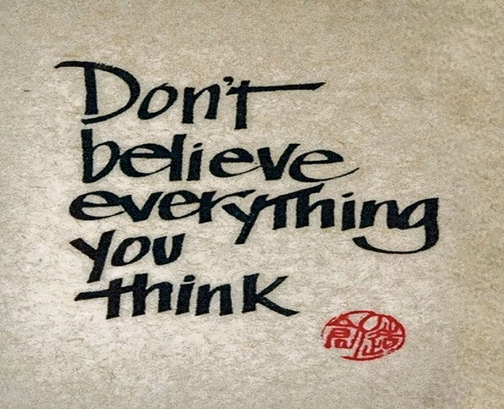
Don’t Believe Everything You Think.
Most of us have an inner critic—one that can get loud, distracting, and sometimes downright rude. And yes, it often feels like this voice stands directly in the way of our creative flow.
But what if the inner critic wasn’t always the enemy?
While popular psychology labels the inner critic as a negative force, the true definition of a critic is simply someone who evaluates, reflects, and forms a reasoned opinion. There’s nothing that says it must devalue your work.
As artists, we spend countless hours creating. Some days everything feels magical; other days, nothing works. This natural ebb and flow is part of the creative process. A healthy, balanced inner critic helps us evaluate our work honestly—challenging us to improve, refine, and grow.
The trouble comes when the critic becomes harsh, judgmental, or discouraging. That’s when it’s time to reclaim your authority. Trust your intuition. Listen to your own artistic voice. When your work brings you joy, that’s a sign you’re on the right path.
Over time, I’ve learned to trust my intuition deeply. I know when an image sings and when it falls flat—I can feel it in my body. That’s not self-judgment; that’s honest awareness.
For years, I used to point out flaws in my work before anyone else could. But most viewers never noticed what I considered “mistakes.” They saw the image through their own eyes, bringing their own experience and interpretation. That taught me to stay quiet, listen, and appreciate their connection to the work.
In the end, the goal isn’t to silence the inner critic entirely. It’s to teach it kindness, give it boundaries, and allow it to support your growth rather than sabotage it.
Name it if you must. Laugh at it. Tell it to step aside when needed.
And then create the work that energizes you—art that is true, honest, and entirely your own.
I’d love to hear from you in the comments below. What does your inner critic tell you?
Be well….be creative,
Clare
Learn how photographs, wax, and intuition come together.
View my photo encaustic classes, courses, and workshops.
You inspire me. I do not create art. I am an artist in my head but it never comes out through my hands. Encaustic photography speaks to me. I’ll continue to appreciate your posts and hope to soon setup an area to begin work.
Thank you Clare.
Barbara
Thanks Barbara. I do so hope that you give photo encaustic a try sometime!
Thanks for this article. It really helps on those days when my creative ebb is low.
You’re welcome. Think of how tiring it would be to have full blown creative energy every day. Wowzers…….we need the ups and downs.
Clare, I like your advice: “learn from your viewers, listen and relish…” Its so difficult to keep quiet and not make excuses for this or that.
I believe that If your work is to be uniquely you, then you have to have the courage to put it out there without (your own) criticism and apology…be content with what moves you and don’t look to others for approval. Deep down you know what moves you..so it’s only your approval that matters.
Its always a risk but that’s what makes a complement so energizing and silence so devastating.
Couldn’t agree more. Creating art is not always easy but on the flip side the rewards can be so incredible.
My inner critic appears when someone asks me if I sell my art. Since I find it so time consuming and confusing I just quit trying to work at sales. Now I wonder what to do with my work so I just hang them on my walls…. hope that someone will come along and buy one and at the same time do not have a clue to a fair price. Those are the times I wonder about myself and if I should be calling myself an artist.
When I am working on as art piece I understand the creative process and know the highs and lows of it, enjoying living it, it is who I am.
Vonnie, calling yourself an artist has nothing to do with selling art and everything to do with creating art. Some artists have no interest in selling work, but if you want to sell, then trust yourself. Would you feel OK with letting it go for XYZ price. Don’t look to others for advice. Just sit with yourself and get a feel for what price feels good to you. Then increase the price a little. Does that still feel OK……until you get to a point where it no longer feels OK.
Clare, timely subject discussion today. As a beginner in photo encaustics my inner critic has at times stopped in dead in my tracks…stifled me to the point of no trying, no experimenting, no production and no fun.So Ive tried to break down my big critisms into smaller bits.( Term eat an elephant one bit at a time comes to mind , terrible image there tho) Also Ive learned to look hard for the good things about a piece.. there is always something, you just have to look… it may not be the over all composition or color combo or style , but it might happen to be how well I got my first layer of medium on this time or I finally achieved a good print out on the tissue etc…… Ive learned to celebrate the small victories which allow me to continue to enjoy the whole big process.
Yes, yes, yes …. it’s so important when learning to celebrate the small victories in a piece. That’s what will keep you fueled and moving forward.
Very timely Clare… I seem to have hit the “encaustic doldrums”,wondering where the inner artist in me has retreated to! During and after your wonderful course things were exciting and progressive but at the moment I feel I’ve hit the wall. Glad to know this is so much a part of the process of growth. Must lighten up!!
Debbie, it’s absolutely part of the process. Just keep at it:)
Great post, Clare, and applicable to all the creative arts (and maybe not-so-creative too).
Thanks Wendy:)
Clare, what you wrote (below) is brilliant – you expressed what I feel, but you didn’t use the words “good” and “bad” – thanks for this perspective.
“Sometimes people will say to me to stop being so hard on myself. But I totally know when an image falls flat. And I totally know when an image sings. It’s being realistic as an artist…..without judgment.”