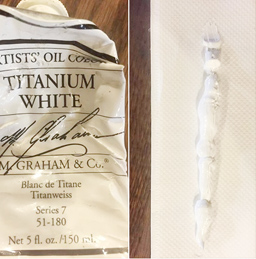
If you know my work, you already know I use a lot of white encaustic paint. And every so often, I find myself in a pinch—out of commercial white and needing a quick solution.
Commercial encaustic paints are made from beeswax, damar resin, and high-quality pigments, often dispersion pigments that are formulated with very little oil. Most of us don’t have dispersion pigments on hand, but we do have artist-grade oil paints. Oil and wax are completely compatible—you just have to be careful about keeping the ratio right.
The rule of thumb is simple: keep the oil paint well under 20% of your mixture.
As you approach a 50/50 ratio of oil to wax, the mixture becomes unstable. You’ll end up with wax that never hardens or oil paint that never properly dries—neither of which you want on your artwork.
When I mix my own encaustic color, I start by squeezing artist-grade oil paint onto a paper towel and letting it sit overnight. This pulls out some of the linseed oil and gives you a more pigment-rich paint to work with. Just make sure the paint doesn’t contain alkyd, since alkyd is a drying agent you don’t want in your wax.
There’s no perfect formula here. Every artist has their own ideal balance of color and translucency. My preference is the intuitive approach—the “invent as I go” method. Over time, you’ll get a feel for how much oil paint to add to melted encaustic medium to achieve the consistency and opacity you want.
Once the paint has released some of its excess oil, simply mix it into your melted encaustic medium.

Stir until fully blended.

then pour the mixture into silicone molds and let it cool.

It’s that simple.

Is it as refined as commercially made encaustic paint?
No. Homemade versions tend to have a slightly waxier finish, which is why I usually rely on Enkaustikos and R&F for the bulk of my colors. But when I’m in a bind—or when I want a very specific hue that I’ve mixed for a particular painting—this method works beautifully.
It’s simple, fast, and surprisingly effective. And sometimes, that’s exactly what we need.
Tell me, what has been your experience with mixing your own encaustic paints?
Be well….be creative,
Clare
Learn how photographs, wax, and intuition come together.
View my photo encaustic classes, courses, and workshops.
This is the method I use also. Very easy to do. Thanks for the update!
This is great Clare. I’ve got all sorts of paints in my studio from bygone days. Looking forward to seeing what encaustic paints I can now create.
thanks Clare- I was looking at your 2016 classes and although the horse one sounds wonderful to me, my kids from Australia will be here. Will the one in Sept. ( in Door county) be a beginner or intermediate workshop? Please keep us posted. Thanks for the blog. k
Oh Kay, it’s too bad you can’t join us for the equine photo encaustic workshop…..it’s going to be fabulous and is really my only workshop that will include beginners and intermediates.
When are you in the cities again? I’d love to get together and chat. Send me an email.
Hi Clare;
I am in your upcoming Basalt class. My interest is in equine and has been forever but have not found the medium of oils enough.
Probably because I am not good enough to leave it alone.
Do you have a equine class coming on your future cshedule?
Joni Keefe
Hi Joni, I’m excited to have another horse lover who wants to learn photo encaustic. I have an Equine Photo Encaustic Workshop coming up in August where we’ll be spending 6 days at Eaton’s Ranch in Wyoming photographing and working on encaustics. The details are here: https://photoencaustic.comclone2/photo-encaustic-equine-workshop/. We can talk about it further next weekend.